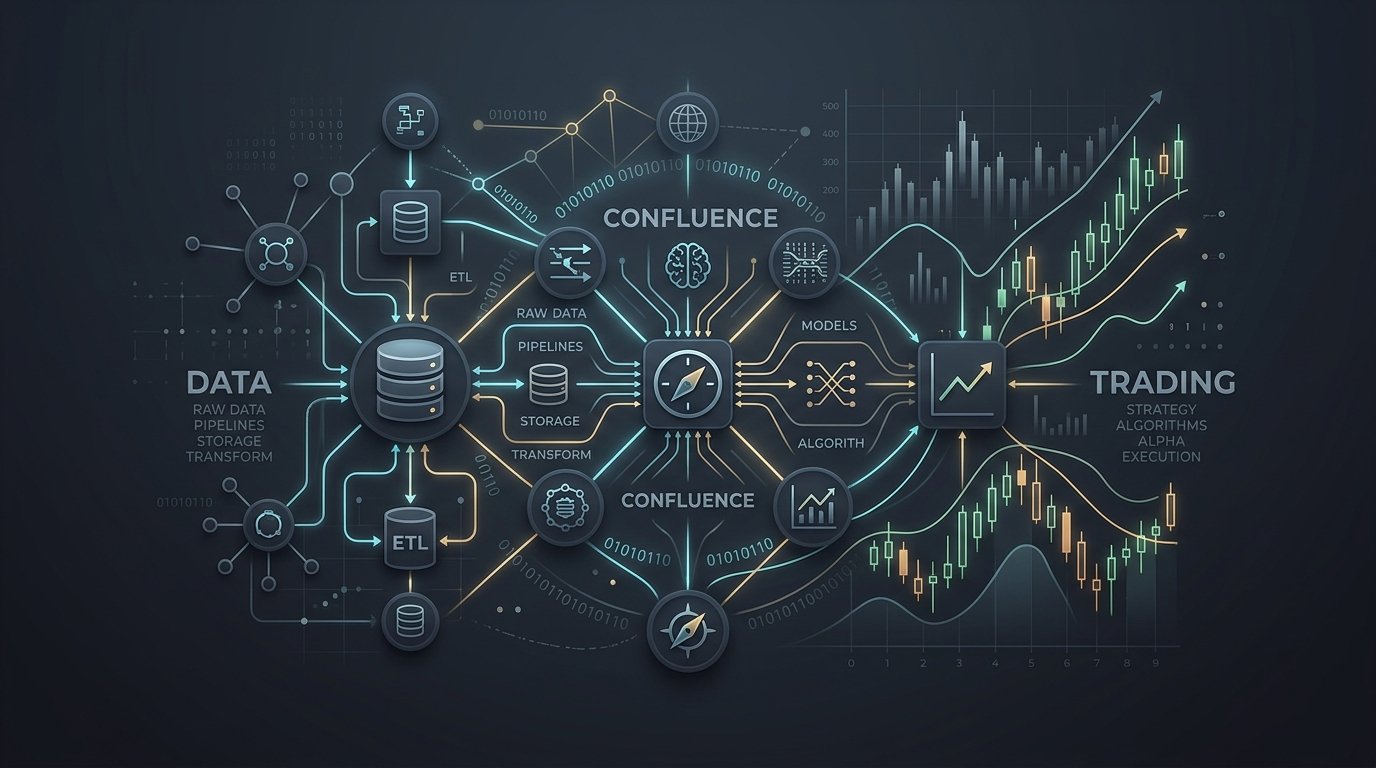
Act I: The Confluence of Data & Markets
My engineering philosophy is built on a simple premise: financial markets are the ultimate big
data challenges. While many treat quantitative trading as pure mathematical modeling, my
focus is on the data infrastructure that feeds those models. A trading signal is only as good as the
order book depth updates, matching engine logs, and tick feeds that generate it.
This perspective led me to merge structural data engineering with high-frequency backtesting. Every
backtest parameter, execution latency metric, and order queuing simulation represents a pipeline that
must be idempotent, testable, and robust under structural market shifts.
"Scaling quantitative systems requires treating trading signals exactly like
data pipelines—idempotent, testable, and robust under structural shifts."
— Nihal Jangave
Act II: Engineering Scalable Systems
By day, I work as a Senior Data Engineer at IQVIA. Here, I lead
development efforts to build large-scale clinical data reviewing, validation, and reconciliation
engines. We manage complex data pipelines handling clinical trial records with strict schema
validations, audit trails, and security requirements.
My daily stack at IQVIA consists of designing streaming clusters with Apache Kafka,
orchestrating data transformations using PySpark and Delta Lake, and
deploying services onto cloud environments via Kubernetes (AKS) and
Docker. Managing healthcare data at scale provides an excellent foundation in data
integrity, schema drift handling, and reliability—skills that translate directly into clean tick data
management for algorithmic trading.
Act III: The Quant Frontier
By night, my focus shifts to the quantitative markets. I develop and backtest
proprietary mean-reversion and momentum strategies on high-frequency cryptocurrency futures data. Rather
than relying on simple vectorized backtesters, I built an event-driven backtesting engine
(AlphaBacktest Engine) in Python to realistically model transaction slippage, execution
latency, and exchange queue delays.
Using 1-minute historical candlestick tick data, my Bollinger Band crossover and volume breakout
strategies have stabilized win rates around 58.2%. This quantitative research is
powered by my custom streaming ingestion daemons, designed in Go and
Python, which stream L2 market depth updates directly into local Kafka partitions and
Delta tables at throughputs exceeding 425k updates/second.
Act IV: Sharing the Blueprint
I believe that true mastery of a system is demonstrated when you can explain it to another developer.
This drive led me into freelance technical authoring. Over the past few years, I've contributed
deep-dives and architectural guides to top developer platforms like LogRocket,
100ms, and DEV.to.
My writing covers containerizing Python worker microservices, managing WebRTC client-side streams, and
optimizing database connection pooling configurations to prevent socket exhaustion under high loads. In
the future, I plan to continue publishing articles at the intersection of quantitative backtesting and
big data infrastructures.